
CEADs Releases City-Level Multi-Regional Input-Output Tables and Energy Footprints
Multi-regional input-output models have become an important method in environmental accounting for quantifying interregional industrial linkages and the coupling between resources, the environment, and economic activity. At present, multi-regional input-output models are mostly built at national and regional or provincial scales, which no longer fully meet the growing need for city-level research. Because city-level data are severely limited and the workload is substantial, compiling city-level multi-regional input-output tables involves many barriers and challenges. The CEADs team has, for the first time, explored a bottom-up framework for compiling multi-level city-level multi-regional input-output tables. Applying this framework to the Beijing-Tianjin-Hebei region, the team compiled multi-regional input-output tables for 13 cities in the Beijing-Tianjin-Hebei urban agglomeration for 2012 and used them to calculate the region's energy footprint. The work reveals, for the first time, the distribution of embodied energy and industrial relationships within the Beijing-Tianjin-Hebei urban agglomeration under industrial linkages, as well as the relationships between cities in Hebei and other provinces. The article was published in the Journal of Industrial Ecology, the journal of the International Society for Industrial Ecology.
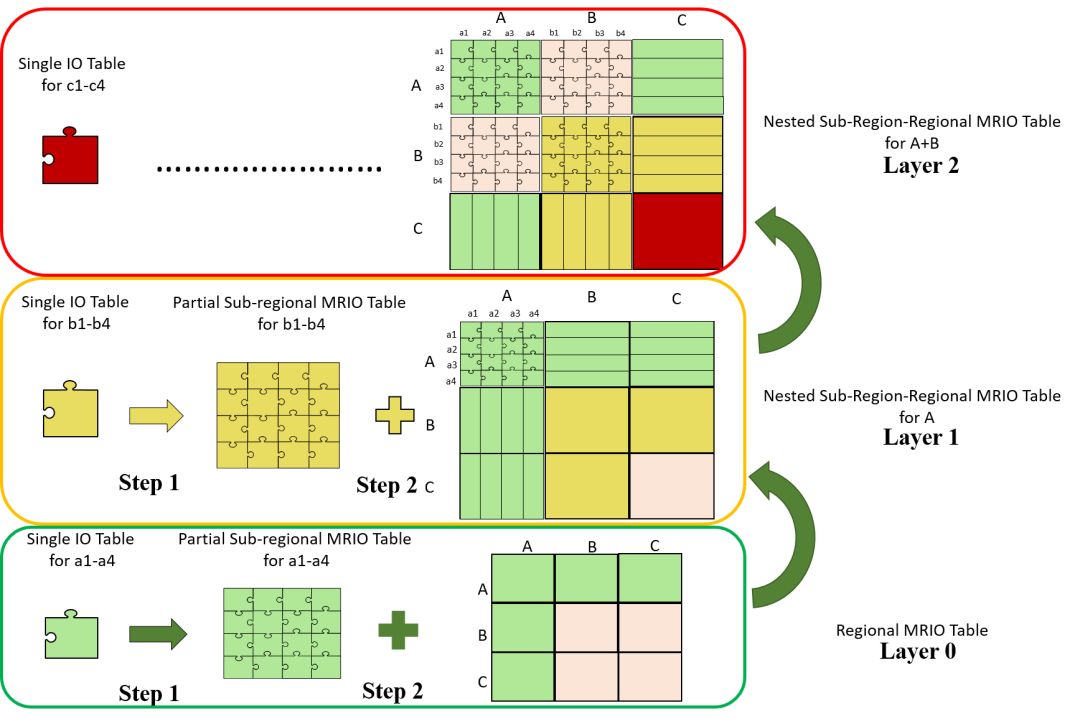
This study adopts a bottom-up compilation approach. It starts by compiling multi-regional input-output tables for 11 cities in Hebei and uses China's provincial multi-regional input-output table as a platform to connect Beijing, Tianjin, and the 11 Hebei cities. The energy footprint results confirm the important role of Hebei's industrial cities in energy supply and consumption. Tangshan, Handan, and Shijiazhuang account for 72% of the embodied energy exported by Hebei, with Tangshan alone accounting for 33%. By contrast, Hengshui and Langfang each account for less than 1%. Consumption in China's less developed regions, including the northeast, west, central, and southwest regions, is the largest driver of embodied energy in Hebei cities' industrial chains. Tangshan, Handan, and Shijiazhuang have also become the main Hebei cities supplying embodied energy to these less developed regions. In contrast, the pull from developed eastern coastal regions on Hebei's embodied energy is limited. Within the Beijing-Tianjin-Hebei urban agglomeration, 63% of the embodied energy in goods and services comes from production in Shijiazhuang, Tangshan, and Handan. Beijing and Tianjin are, as expected, the largest consumption destinations. Energy footprints from Hebei account for 20% and 14% of the relevant inflowing energy footprints of Beijing and Tianjin, respectively, mainly from Shijiazhuang, Tangshan, and Handan.
The compilation of city-level input-output tables is still at an exploratory stage worldwide. The CEADs team is continuing to test different approaches and methods, with the aim of developing an efficient, accurate, and transparent framework for compiling city-level multi-regional input-output tables. Comments and suggestions from scholars are welcome.
Special thanks go to Professor Malin Song of Anhui University of Finance and Economics for his strong support of the CEADs team's work on compiling city-level input-output tables.
Article information: Zheng H, Meng J,
Mi Z, et al. Linking city-level input-output table to urban energy footprint:
Construction framework and application. J Ind Ecol. 2018;1-15.
https://doi.org/10.1111/jiec.12835