
CEADs Data: 2015 Multi-Regional Input-Output Tables for 31 Provinces and 42 Sectors Released
The CEADS team has constructed, for the first time, China's 2015 multi-regional input-output tables covering 31 provinces and 42 sectors, and calculated the regional characteristics and socioeconomic impacts of consumption-based carbon emissions from 2012 to 2015. The paper has been published in Environmental Research Letters. The Excel files have been uploaded to the CEADS data platform and are shared free of charge (http://www.ceads.net/data/input-output-tables/). We welcome everyone to download, verify, use them, and share valuable feedback.
Based on the latest multi-regional input-output tables, Dr. Heran Zheng of the CEADs team led a study on the regional characteristics and socioeconomic impacts of China's consumption-based carbon emissions.
Since the financial crisis, China's economy has entered the New Normal. Along with economic restructuring, the characteristics of China's carbon emissions have changed substantially. Under the New Normal, the economic structure, energy structure, and consumption patterns all show changes different from the past, and each region plays a different role in this process. China's economic transition and carbon emissions have long been widely discussed. However, most studies have focused mainly on production-based emissions, emphasizing local production and energy consumption, while paying insufficient attention to the interregional interdependence driven by consumption and connected through supply chains.
This study combines an entropy model and a gravity model to build a framework for compiling multi-regional input-output tables. To ensure methodological consistency, the framework is used to compile China's 2012 and 2015 multi-regional input-output tables for 31 provinces and 42 sectors, linked with the GTAP global model. Based on these tables, consumption-based emissions for each Chinese region in 2012 and 2015 are calculated, and regional consumption-based emissions in 2013 and 2014 are estimated. Finally, a structural decomposition model is used to quantify the socioeconomic factors behind changes in consumption-based emissions from 2012 to 2015.
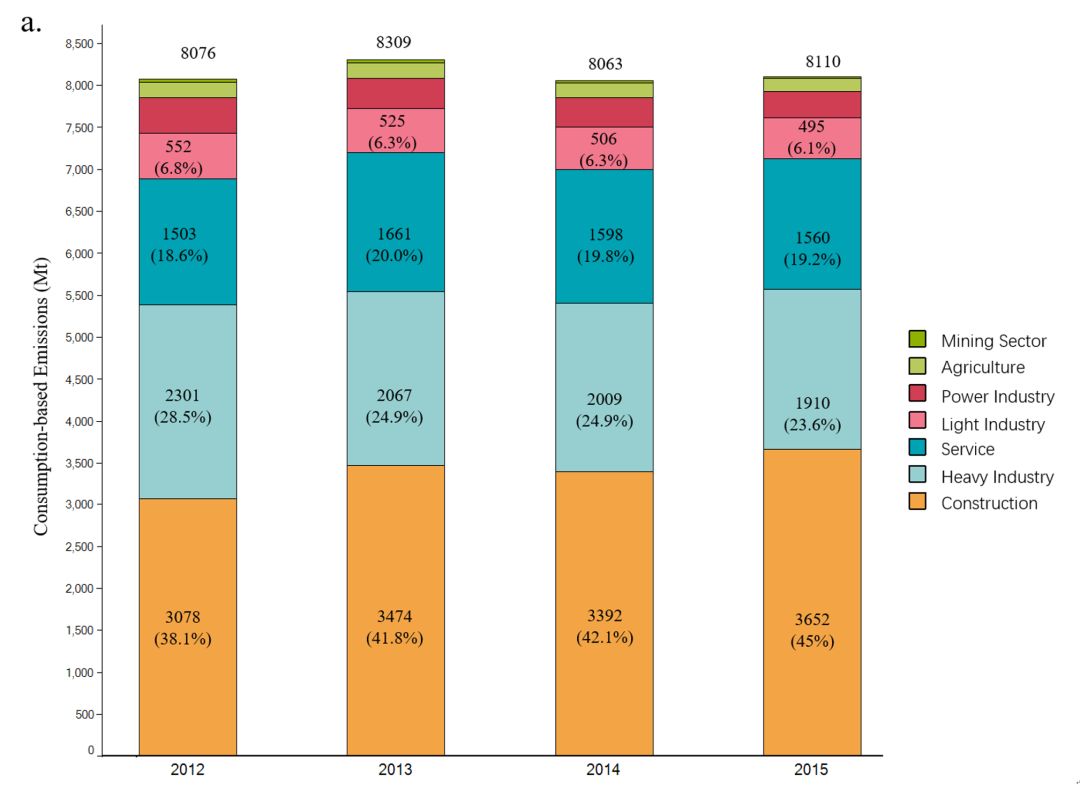
a. China's consumption-based emissions, 2012-2015 (by sector)
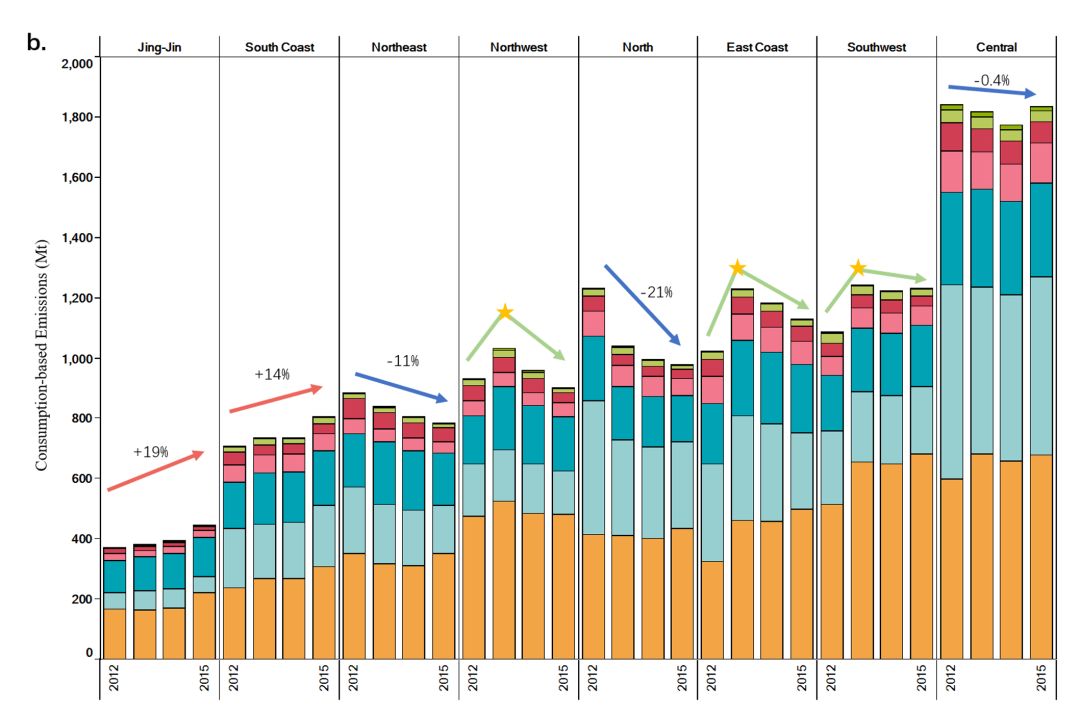
b. Regional consumption-based emissions, 2012-2015 (by sector)
The study finds that China's consumption-based carbon emissions peaked in 2013 at 8,309 million tonnes and then declined. From 2012 to 2015, economically less developed regions showed a downward trend, indicating that before 2012, Northeast China and North China had already reached their peaks. Northwest, Southwest, and East China peaked in 2013, while consumption-based emissions in the Beijing-Tianjin region and the southern coastal region continued to rise. Central China fluctuated during this period.
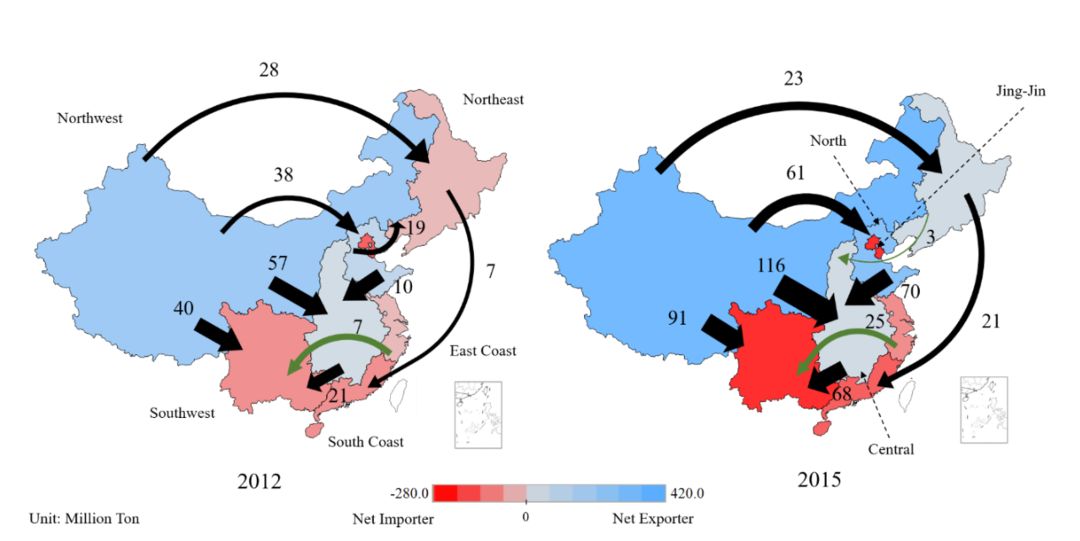
Comparing regional consumption-based carbon accounting in 2012 and 2015, Southwest China and Central China became new growth poles for consumption-based carbon accounting, and embodied carbon emissions in trade showed a trend of concentrating in Southwest and Central China. This is closely related to industrial relocation and upgrading, as well as infrastructure investment under the Belt and Road Initiative.
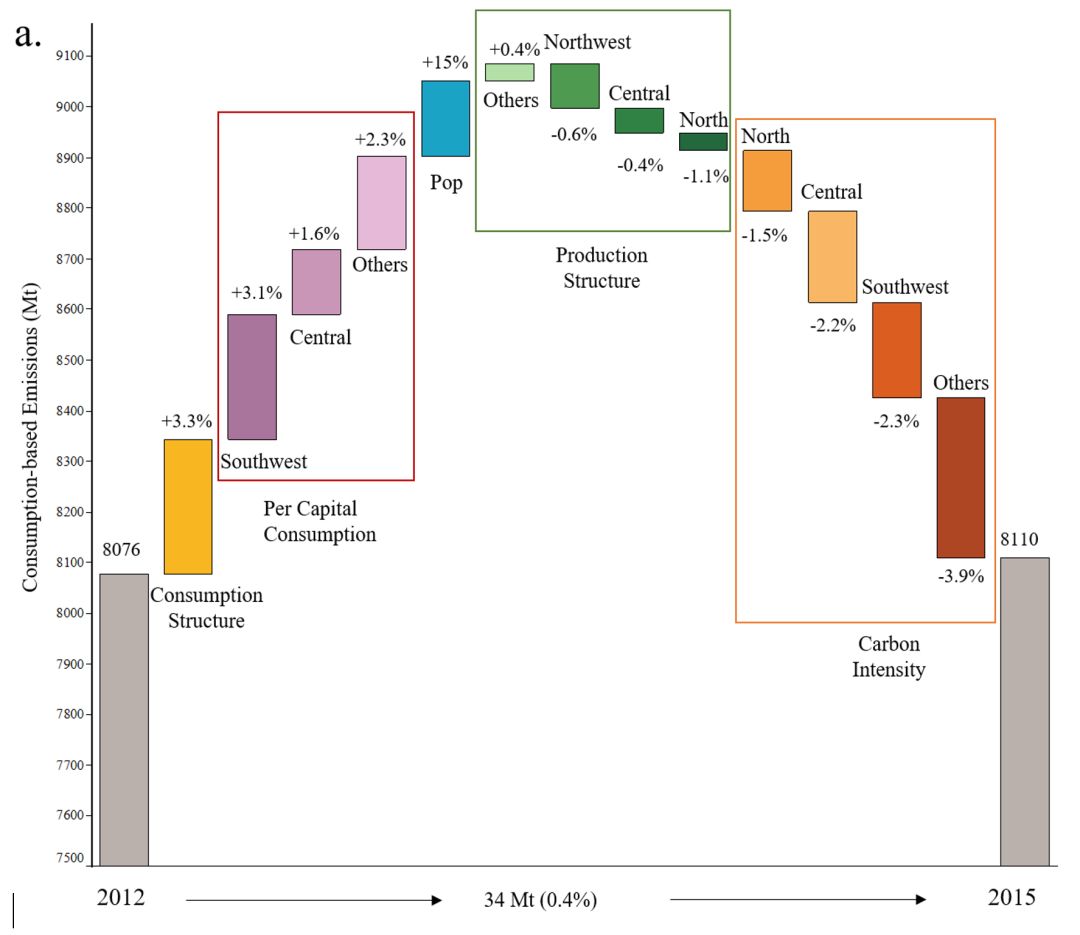
The structural decomposition model shows that the main reason for the decline in China's consumption-based carbon emissions is the decrease in carbon intensity. In particular, the use of clean technologies and energy in North China, Central China, and Southwest China was the main driver of lower consumption-based emissions. Adjustments in production structure, especially in Northwest China, Central China, and North China, made the largest contribution to reducing consumption-based emissions. By contrast, per capita consumption in Central China and Southwest China became the main factor pushing up consumption-based emissions.
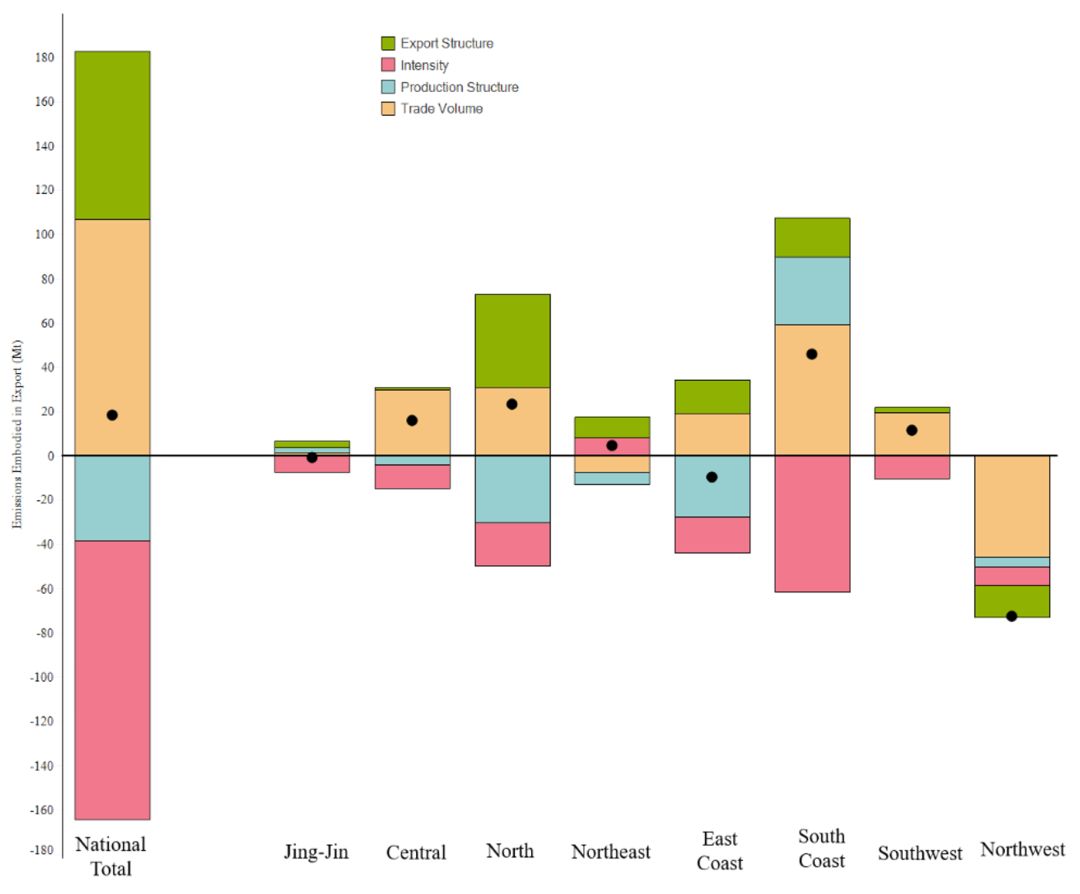
For export-related carbon emissions, China's emissions rebounded in 2015, mainly due to a surge in export volume and changes in the export structure of East China and North China. More details are available in the paper:
Heran Zheng, Zengkai Zhang, et al. Regional determinants of China's consumption-based emissions in the economic transition. Environ. Res. Lett. in press https://doi.org/10.1088/1748-9326/ab794f