
CEADs Release: China's National and Provincial Emission and Energy Inventories for 2014-2019 (Including Revisions to Statistical Data Since 2014)
Research Background
Data are the foundation of work in the field of climate change. The transparency, accuracy, completeness, comparability and consistency of energy statistics are fundamental to estimating carbon dioxide emissions, formulating emission reduction policies, promoting energy transition and mitigating climate change. The National Bureau of Statistics of China has been working to improve the timeliness and accuracy of statistical data. It recently released the China Energy Statistical Yearbook 2020 and, in the China Energy Statistical Yearbook 2019, revised energy consumption data since 2014 based on the results of the Fourth National Economic Census.
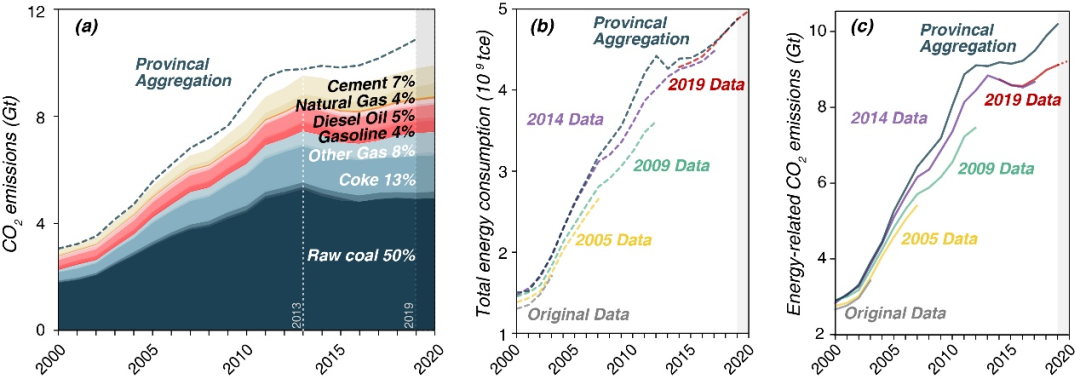
On this basis, the CEADs team recently published Assessment to China's recent emission pattern shifts in Earth's Future. The study calculates energy and carbon dioxide emission inventories for China's 31 provinces from 2014 to 2019, including updated national emission inventories for 2014-2017 based on the latest revised energy activity data from the National Bureau of Statistics. The updated inventories follow the previous accounting methods and scope, covering 47 socioeconomic sectors, 17 types of fossil fuel combustion and process emissions related to cement production.
Research Findings
China's total carbon emissions reached a phased peak around 2013 and have since fluctuated at a high level, reaching about 9.8 billion tonnes in 2019. Preliminary estimates based on the Statistical Communique of the People's Republic of China on the 2020 National Economic and Social Development indicate that national carbon emissions may have risen to 9.93 billion tonnes in 2020, an increase of 1.4% from 2019. Economic recovery after the COVID-19 pandemic drove the continued increase in total carbon emissions in 2020.
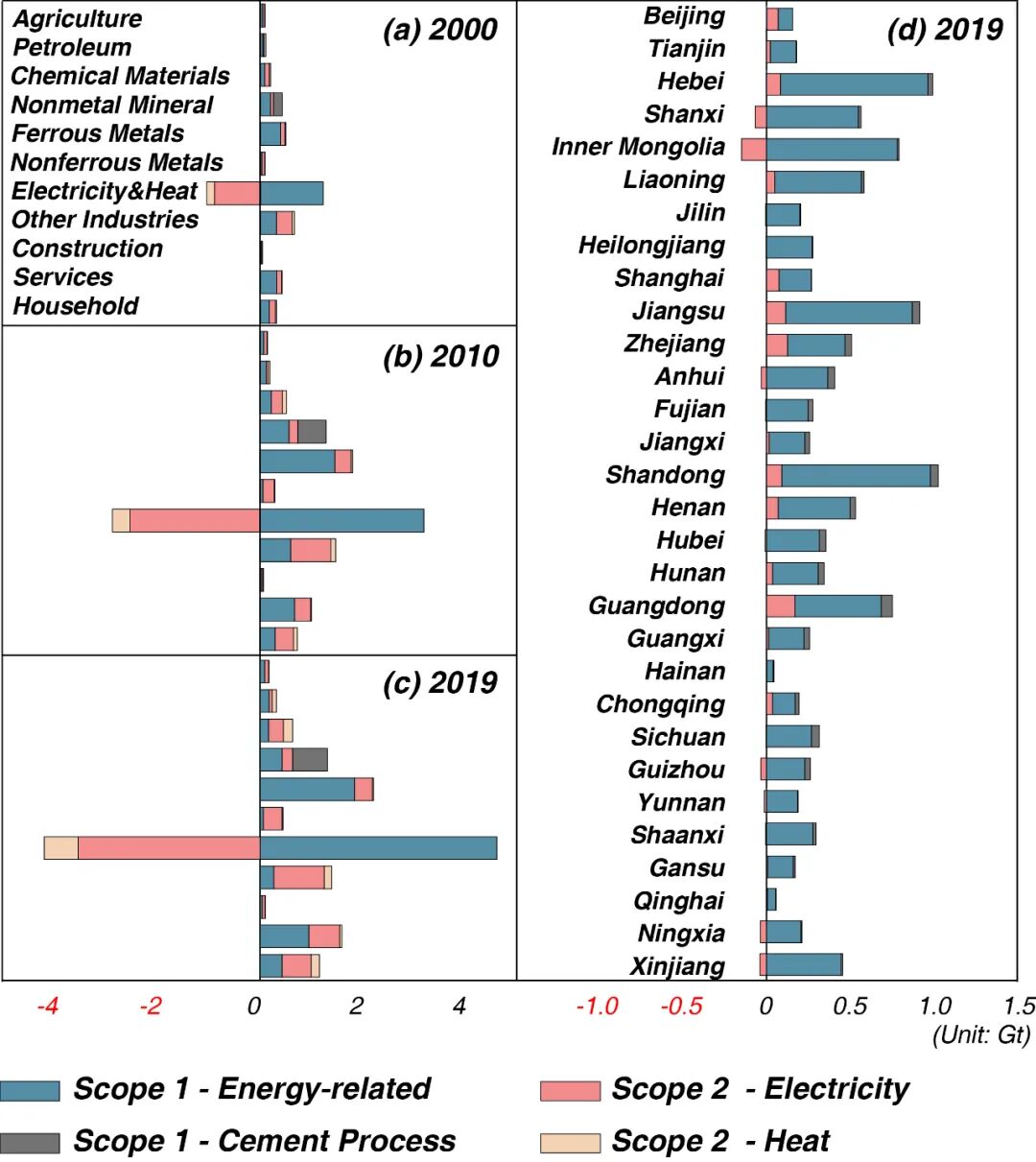
Sectoral emission inventories show that most carbon emissions come from six major energy-intensive industries. Scope 2 accounting reallocates indirect emissions generated by net purchased electricity and heat to consumers. Combining the two accounting approaches provides a comprehensive assessment perspective. At the provincial level, because of the complex relationships between electricity and heat supply and demand across regions, integrated provincial emission inventories show greater heterogeneity.
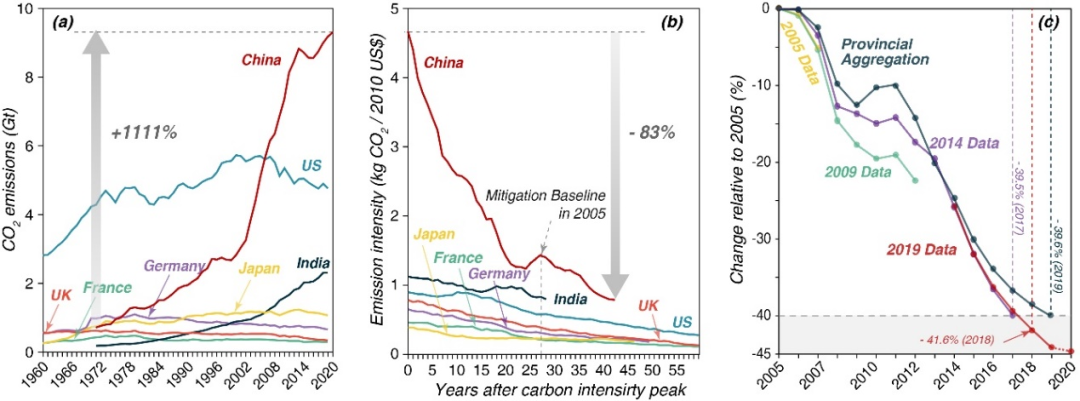
The accounting results show that China achieved ahead of schedule the 2020 target of reducing carbon emission intensity by 40-45%, which was set in the Opinions of the CPC Central Committee and the State Council on Accelerating the Promotion of Ecological Civilization Construction in 2015. However, China is still in the process of industrialization and urbanization and continues to face a series of challenges on the path toward peaking carbon emissions by 2030 and achieving carbon neutrality by 2060.
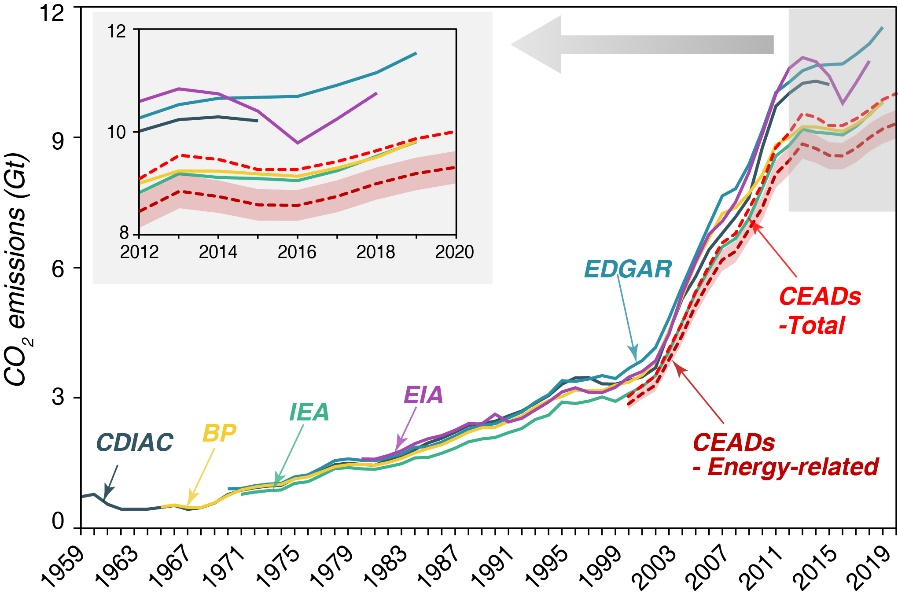
The latest data show that the accuracy of China's energy statistical systems at all levels has improved significantly, while the uncertainty of carbon emission estimates has declined year by year. After four rounds of data revisions, the discrepancy between national and aggregated provincial emission data has been significantly reduced. Comparisons with databases from developed Western countries show that their estimates of China's carbon dioxide emissions have errors ranging from 7.8% to 17.8%, which do not reflect China's actual circumstances and contain substantial deviations.
Reliable and transparent energy statistics and emission inventories are critical for setting and evaluating climate change mitigation targets. In carbon accounting, building an open, transparent, comparable and verifiable emissions database is fundamental to climate change research. This is also the original purpose of CEADs' long-term work.
Article Information
Paper Download Link:
https://doi.org/10.1029/2021EF002241
Citation: Yuru Guan, Yuli Shan* et al. (2021). Assessment to China's recent emission pattern shifts. Earth's Future.
Free Data Download:
National Inventory
https://www.ceads.net/data/nation/
Provincial Inventory
https://www.ceads.net/data/province/