
CEADs Releases 2005-2019 CO2 Emission Accounts for Russia and Its 82 Federal Subjects
Research Background
Against the backdrop of global climate change, compiling carbon emission inventories is a cornerstone for implementing effective emission reduction plans. Compared with national-level accounting, regional emission accounting is important for identifying emission priorities and focusing mitigation efforts. The CEADs database has long been committed to building an open, transparent, comparable, verifiable, and free carbon emission accounting database. Building on the initial establishment of the China carbon accounting system and using mature methods, the CEADs team has carried out accurate carbon emission accounting for countries related to the Belt and Road Initiative.
Russia is the largest oil and natural gas exporter in the world and the fourth-largest carbon dioxide emitter globally. Its efforts to mitigate carbon dioxide emissions are therefore important for curbing climate change. However, academic research on carbon emission trends in Belt and Road countries remains limited. In particular, detailed emission inventories for resource endowments, energy structures, and fossil fuel categories at the regional scale in large developing countries are still largely absent.
To address this research gap, a CEADs research group led by Huijuan Xiao and Weichen Zhao conducted regional-scale carbon emission accounting for Russia from 2005 to 2019 at the level of federal subjects. The results were published in Scientific Data. The related data can be downloaded free of charge from the CEADs website (www.ceads.net.cn). This study uses emission factors that better represent Russia and systematically constructs transparent, accurate, complete, comparable, and consistent carbon emission accounts for Russia and its 82 federal subjects, covering 89 socioeconomic sectors and 17 energy types. The inventory can provide a data foundation for studying emission patterns and mitigation strategies in Russia, and can also support carbon-emission-related comparative research at global and cross-country scales.
Data Introduction
(1) Carbon emission accounts related to fossil fuel combustion for Russia and 82 federal subjects from 2005 to 2016, covering 17 energy types.
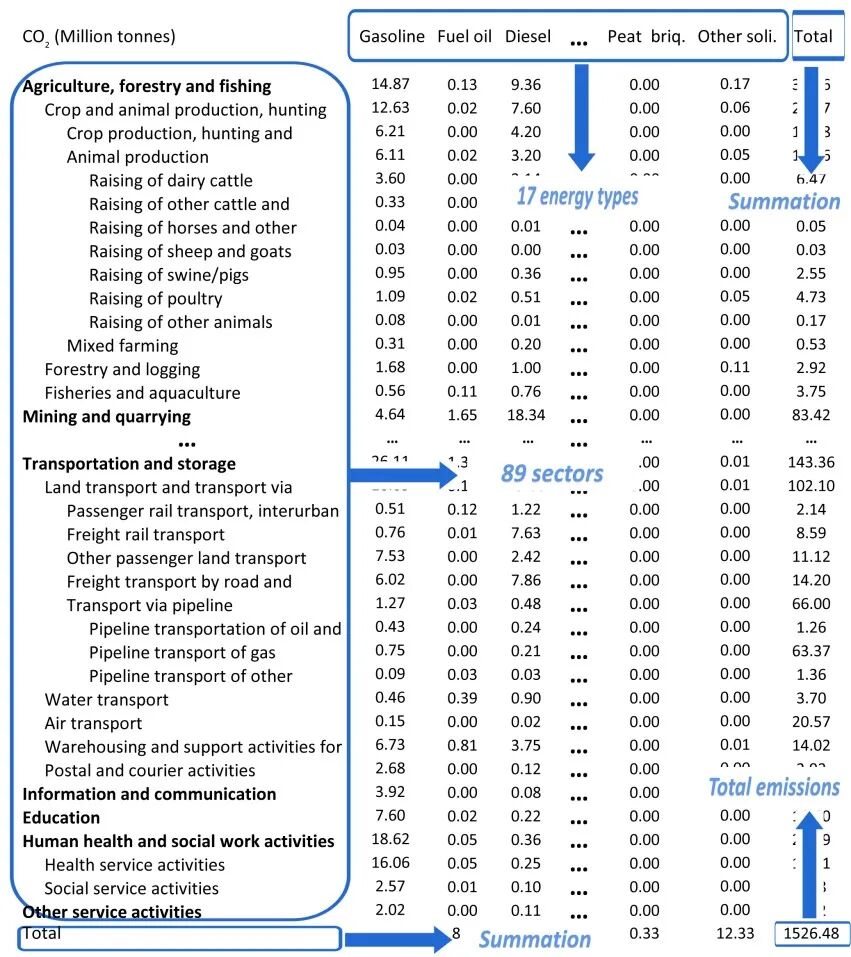
(2) Carbon emission accounts related to fossil fuel combustion for Russia and 82 federal subjects from 2017 to 2019, covering 89 sectors and 17 energy types, as shown in Figure 1.
(3) Carbon emission accounts related to cement production for Russia and 82 federal subjects from 2005 to 2019.
Research Methods and Results
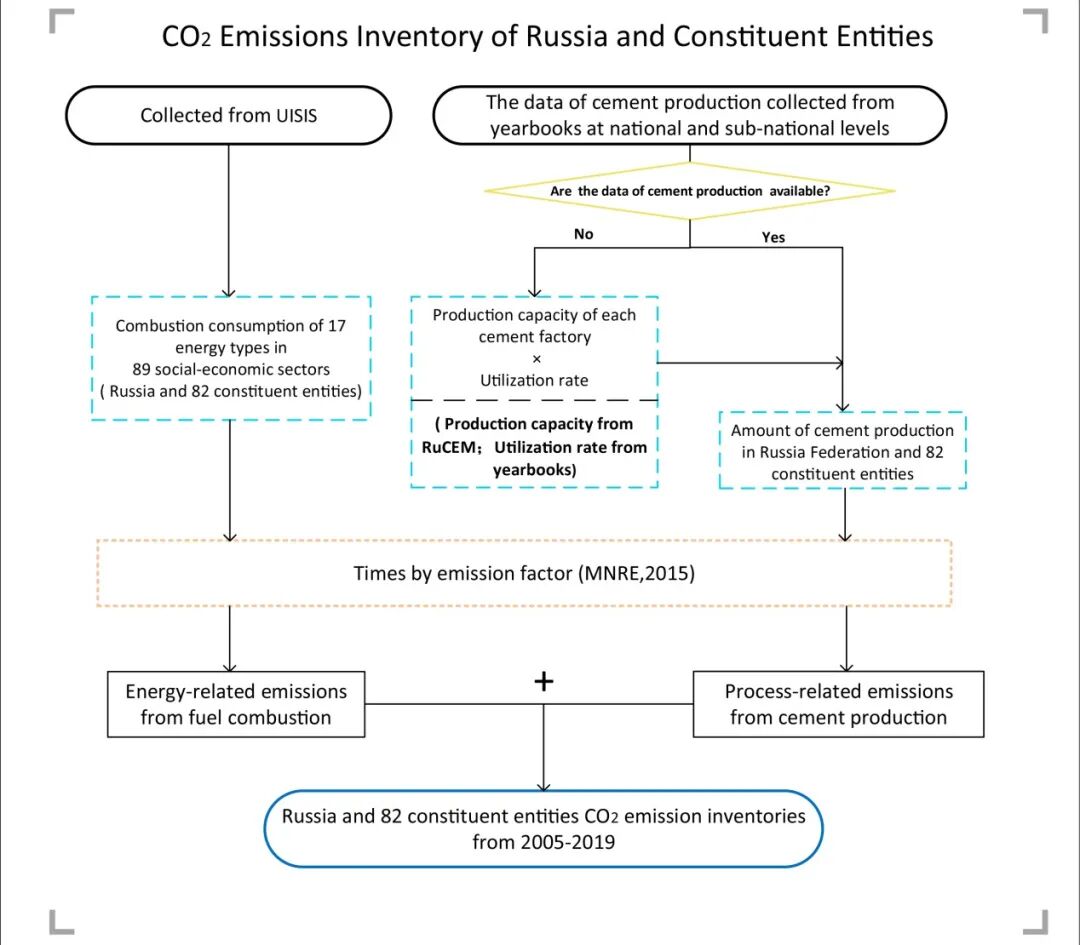
The construction process for the carbon emission accounts is shown in Figure 2. Based on the IPCC methodology for compiling carbon dioxide inventories, using the CEADs unified-format and unified-statistical-standard emission inventory as a template, and drawing on fossil energy consumption data from Russia the Unified Interdepartmental Statistical Information System (UISIS) and emission factors for more than one hundred energy products released by the Ministry of Natural Resources and Environment of the Russian Federation (MNRE) in 2015, the study calculated carbon emissions related to fossil fuel combustion in Russia. Meanwhile, cement production in Russian regional statistical yearbooks was cross-checked with point-source data for Russian regions in the CEADs global cement plant database to calculate carbon emissions related to cement production in each region.
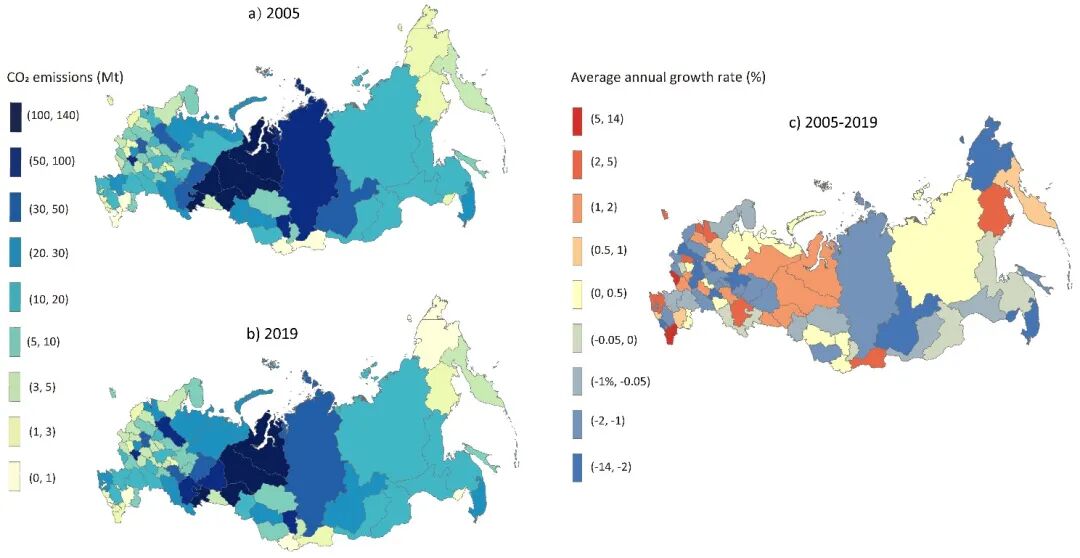
Changes in carbon emissions among Russia 82 federal subjects from 2005 to 2019 are shown in Figure 3. Tyumen Oblast and Chelyabinsk Oblast were the two largest emitting federal subjects in Russia in 2019, emitting 137.66 million tonnes and 119.34 million tonnes of carbon dioxide, respectively. This is because Tyumen Oblast is the largest oil and natural gas production area in Russia. Chelyabinsk Oblast has abundant mineral resources that strongly support industrial development, with 76.82% of its carbon emissions coming from basic metal manufacturing. Moscow, the largest city and capital of Russia, emitted 79.05 million tonnes of carbon dioxide.
From 2005 to 2019, carbon emissions increased in 45.12% of Russian federal subjects. Tyumen Oblast recorded the largest increase, adding 24.26 million tonnes of carbon dioxide, mainly due to higher natural gas demand. It was followed by Lipetsk Oblast, which increased by 19.53 million tonnes of carbon dioxide. By contrast, Sverdlovsk Oblast saw the largest decrease from 2005 to 2019, with carbon dioxide emissions falling by 15.50 million tonnes, mainly because of declining demand for associated petroleum gas and coal.
Data Citation
Free Data Download:
Or visit https://www.ceads.net/data/global_countries/Russia/ .
Data and Article Citation:
Xiao, H., Zhao, W. et al.CO2 emission accounts of Russia’s constituent entities 2005–2019. Sci Data 8,172 (2021). https://doi.org/10.1038/s41597-021-00966-z