
Database Release: Global Energy Infrastructure Emissions Database Launched for Trial Operation
The current global economy is highly dependent on fossil energy. Infrastructure for producing and consuming fossil energy emits large amounts of greenhouse gases and air pollutants during operation, causing serious impacts on climate change, air quality, and human health. Energy infrastructure often has a service life of several decades. Newly built high-carbon infrastructure in rapidly developing countries will generate substantial carbon emissions in the future, known as locked-in carbon emissions, posing a serious threat to the low-carbon energy transition and the achievement of carbon neutrality goals. Energy infrastructure is the basic unit of greenhouse gas and air pollutant emissions, and it is also the focal point for formulating climate change and air pollution control strategies. For a long time, however, infrastructure data in many countries and regions has not been transparent or publicly available, and unified data foundations and technical methods have been lacking. As a result, most current studies on emissions and climate-environment impacts in key global sectors can only be conducted at the macro sectoral scale, providing insufficient support for scientific research and policy decision-making.
With support from organizations including Energy Foundation China, the National Natural Science Foundation of China, the Ministry of Science and Technology key R&D program, and the Ministry of Ecology and Environment, Tsinghua University has worked with multiple domestic and international institutions and teams since 2018 to develop and maintain the Global Energy Infrastructure Emissions Database, or GID. The database aims to build a facility-level global database of basic information and emissions for energy production and consumption infrastructure, providing foundational data support for scientific research and policy assessment. The GID development team has mined multiple global and regional energy infrastructure databases, compiled information on more than 100,000 operating energy production and consumption facilities worldwide, and developed a unified emissions characterization model using big-data methods. This enables facility-level accounting of carbon dioxide and air pollutant emissions.
The GID team is committed to providing the scientific community with high-resolution global emissions data products for energy production and consumption infrastructure. The GID website is now online for trial operation, alongside the release of 2019 enterprise-level basic information and carbon dioxide emissions data for three key global sectors: power, steel, and cement. It also provides aggregated information on capacity, service age, and emissions at national, regional, and global scales. We welcome everyone to follow the project and download the data.
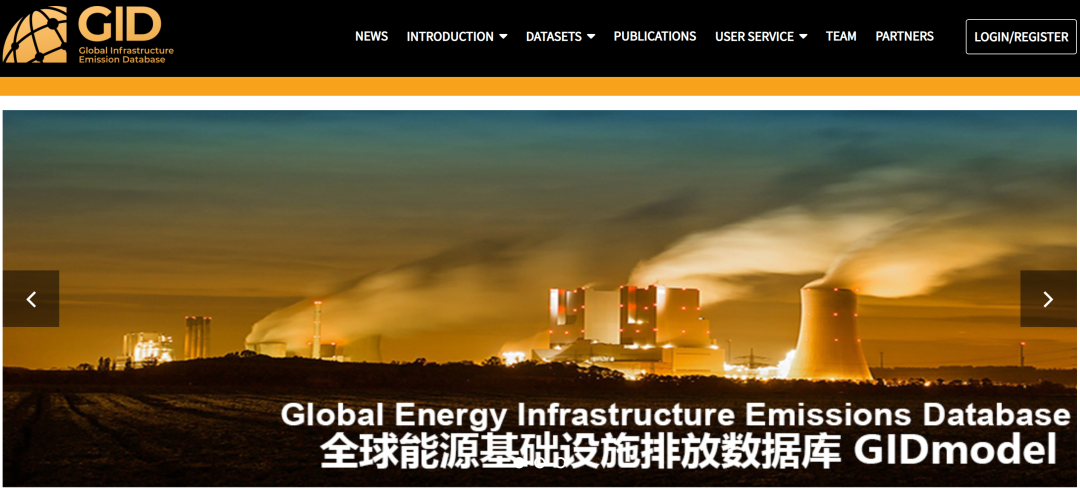
Website: http://gidmodel.org/
We are committed to building GID into an open research platform and making sustained contributions to global and regional research on climate change and low-carbon development. We invite teams and individuals interested in developing the GID database to join us in collaborative development and provide the scientific community with more detailed, accurate, and user-friendly energy infrastructure emissions data products. If you are interested in contributing to GID, please contact the GID team at gid@tsinghua.edu.cn.
In the future, the GID database will continue to be updated and the latest emissions data products will be released on the website. By building a long time-series emissions database, GID will track the dynamic changes of energy infrastructure while also developing infrastructure databases for other key sectors. It will expand the coverage and applications of the database across time, space, sectors, and other dimensions. We welcome exchanges and collaboration with the GID team.