
CEADs Releases 2020-2021 National and Provincial Emissions Inventories
Research Background
As the issue of global climate change becomes increasingly severe, countries are paying growing attention to carbon emissions. As one of the world's largest carbon emitters, China's emissions data have drawn wide international attention. Reliable and transparent energy statistics and emissions inventories are essential for China to achieve its carbon peaking and carbon neutrality goals. Compiling accurate, multi-scale, open, transparent, comparable, verifiable carbon emissions inventories with independent intellectual property rights has long been the CEADs team's original motivation.
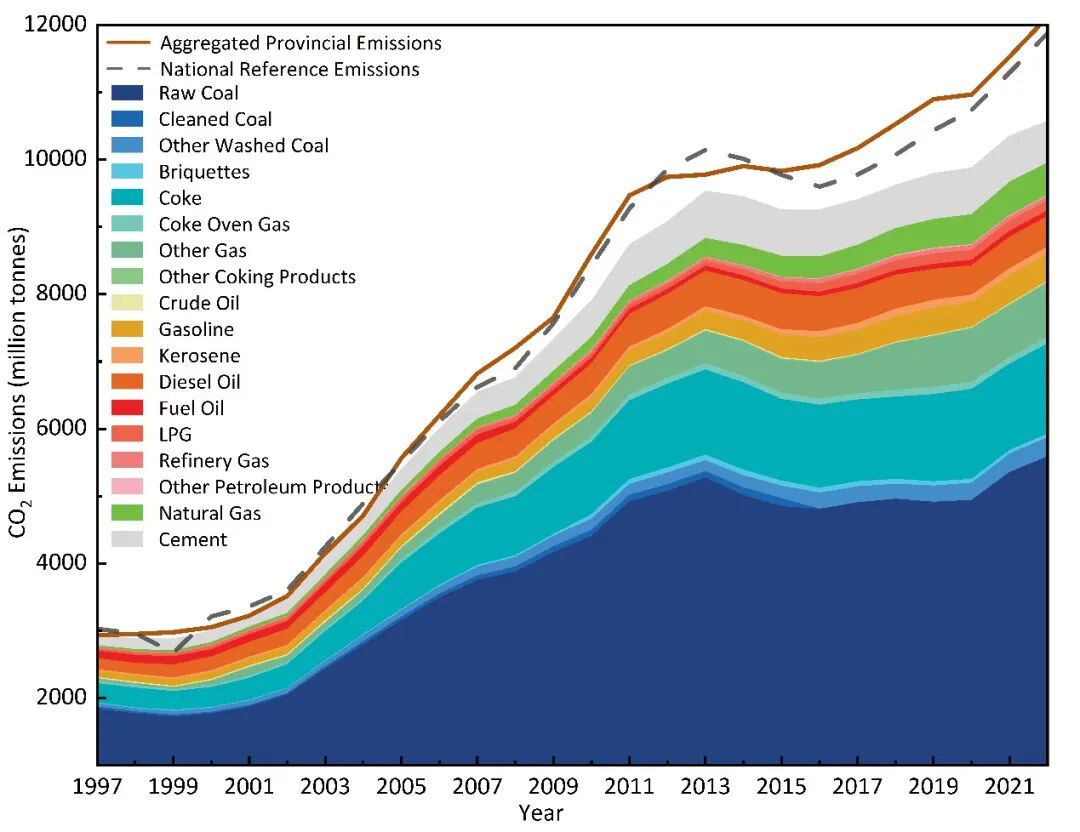
Recently, the CEADs team officially released the 2020-2021 energy and carbon dioxide emissions inventories for China's national level and 30 provinces, and updated the emissions data for the past five years. This update follows the same accounting methods and scope as previous versions, covering 47 socioeconomic sectors and emissions from 17 fossil fuel combustion types and cement production processes. It presents recent trends in China's carbon emissions and provides researchers with clear and reliable data support.
Data Results
The latest emissions data show that the impact of the COVID-19 pandemic on energy-related emissions was temporary. Affected by the pandemic, China's carbon emissions in 2020 remained relatively stable. With the strong economic recovery in 2021, carbon emissions rebounded slightly.
The data also show that China has achieved notable results in adjusting its industrial structure, improving energy efficiency, optimizing its energy mix, controlling non-energy greenhouse gas emissions, increasing carbon sinks, strengthening the coordinated control of greenhouse gases and air pollutants, and promoting low-carbon pilots and local actions. By the end of 2020, China's emissions intensity had fallen by 19.3% compared with 2015, exceeding the 18.0% reduction target set in the 13th Five-Year Plan.
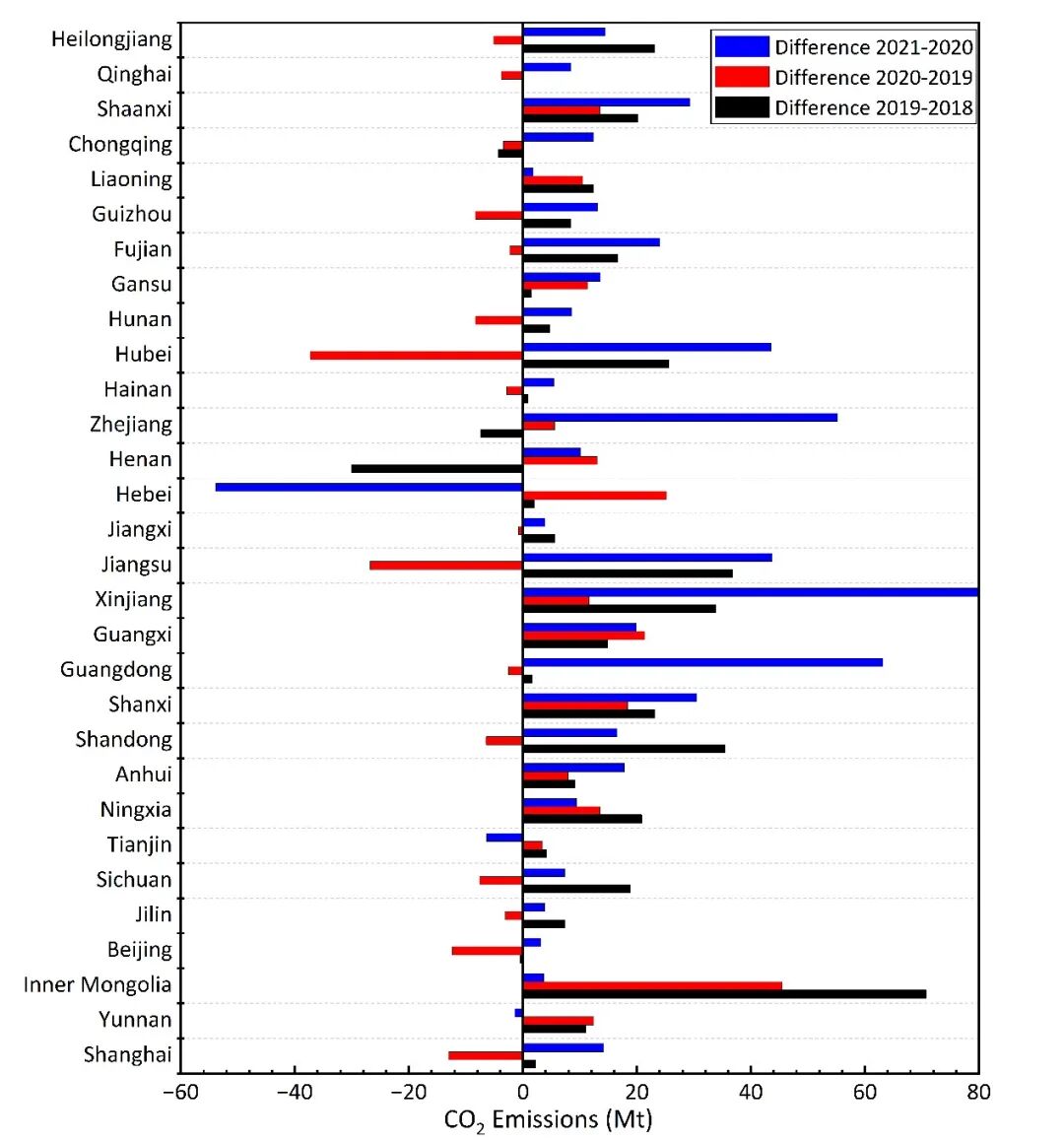
The provincial inventory shows that more than two-thirds of China's provinces experienced declines in carbon dioxide emissions in 2020. In particular, Jiangsu and Shandong, both manufacturing-led provinces, saw relatively pronounced downward trends. More developed regions such as Beijing, Shanghai, Hubei, and Fujian also recorded significant declines. Meanwhile, western provinces such as Shaanxi, Ningxia, and Yunnan were less affected by the pandemic in 2020. As the socio-economic recovery accelerated in 2021, emissions in most provinces rose, especially in energy-intensive regions such as Shanxi, Xinjiang, Jiangsu, and Hebei.
Data Information
- CEADs data are open and transparent, available for free download -
National inventory: https://www.ceads.net/data/nation/
Provincial inventory: https://www.ceads.net/data/province/
Data references:
1. Xu, J., Guan, Y., Oldfield J., Guan, D., & Shan, Y.* (2023). China emission accounts from energy use and changing patterns since 2020. under review.
2. Guan, Y., Shan, Y.*, Huang, Q., Chen, H., Wang, D., & Hubacek, K. * (2021). Assessment to China's Recent Emission Pattern Shifts. Earth's Future, 9(11).
3. Shan, Y.*, Huang, Q., Guan, D., & Hubacek, K.* (2020). China CO2 emission accounts 2016-2017. Scientific Data, 7(1).
4. Shan, Y., Guan, D.*, Zheng, H., Ou, J., Li, Y.*, Meng, J., Mi, Z., Liu, Z.*, & Zhang, Q. (2018). China CO2 emission accounts 1997-2015. Scientific Data, 5, 170201.
5. Shan, Y., Liu, J., Liu, Z., Xu, X., Shao, S., Wang, P. & Guan, D.* (2016). New provincial CO2 emission inventories in China based on apparent energy consumption data and updated emission factors. Applied Energy, 184, pp.742-750.
For inquiries, please contact Shan Yuli.
shanyuli@outlook.com.