
Registration Countdown | CEADs Summer School Introduces the Carbon Neutrality Young Scholar Challenge Award


7th
2025 China Emission Accounts and Datasets (CEADs) Summer School
One week left to register!
- CEADs Summer School -

Designed to advance the national dual-carbon strategy, the 2025 CEADs Summer School is dedicated to training globally minded professionals in carbon mitigation and empowering young scholars to become future leaders in the carbon peaking and carbon neutrality transition.
Registration is now entering its final countdown. Secure your place in the final week and join us in Huzhou, Zhejiang Province for a sustainable summer.
01
CEADs Scholarships

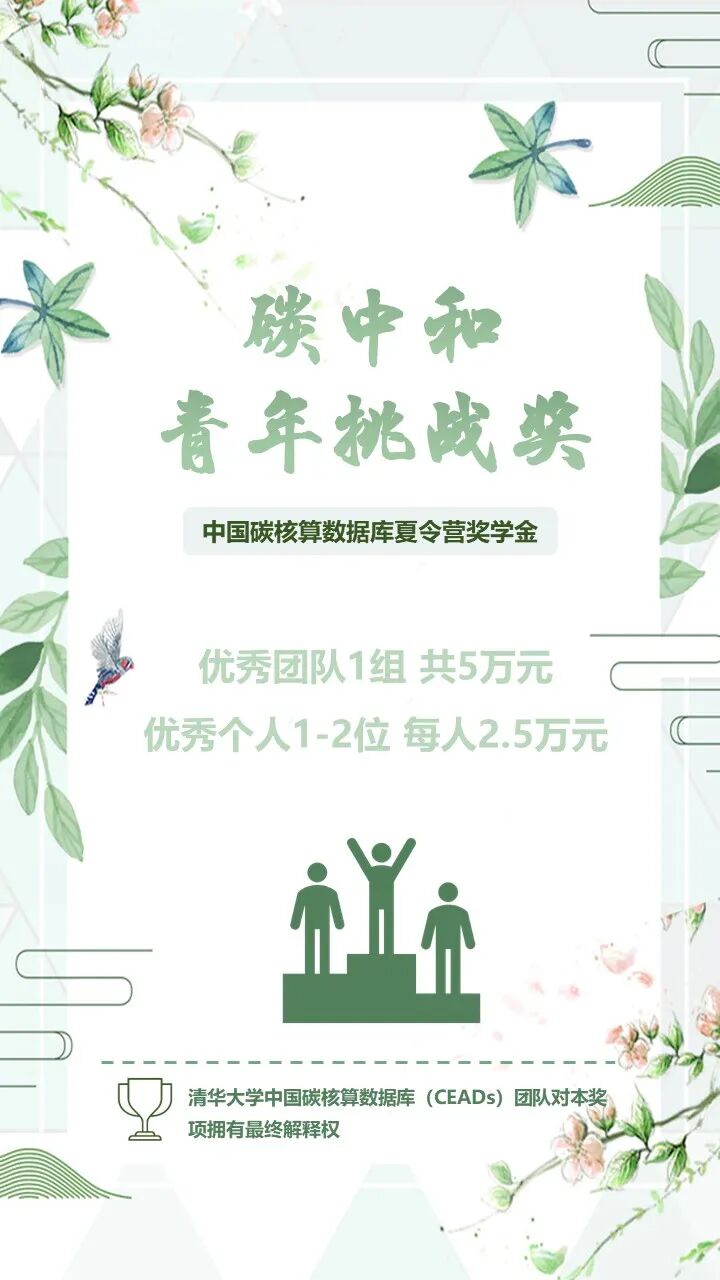
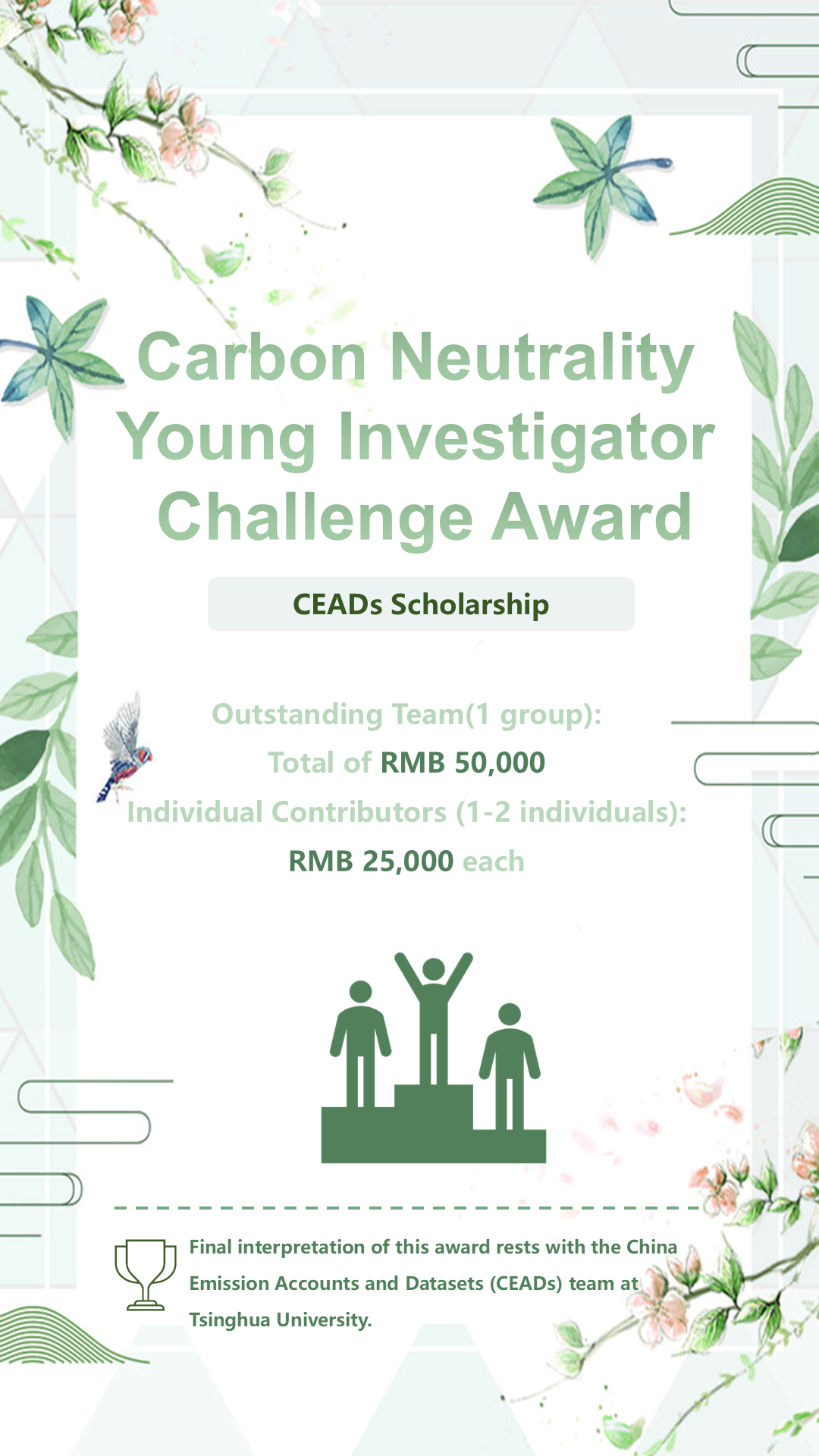
In 2025, the CEADs Summer School will introduce the Carbon Neutrality Young Scholar Challenge Award. The award provides RMB 50,000 for each outstanding team and RMB 25,000 for each outstanding participant. Funded by philanthropic donations, the award aims to identify and support young teams and individuals with talent in carbon neutrality, especially in carbon accounting, who are committed to continued exploration in the field.
No more than one outstanding team and up to two individual contributors will be selected. Award recipients may use the prize funds at their own discretion. The final evaluation will take place during the closing presentation session of the summer school, where leading climate change experts invited by the CEADs team at Tsinghua University will vote and score the presentations. Award-winning teams and individuals will receive prize money, trophies, and honorary certificates.
All participants who complete the summer school with satisfactory performance will receive a certificate of participation issued by the Tsinghua University Institute for Carbon Neutrality.

02
Event Introduction

1. Introduction to CEADs
Since the announcement of China carbon peaking and carbon neutrality goals, the Central Committee of the Communist Party of China and the State Council have placed great emphasis on building a standardized carbon accounting system and have called for a unified national framework. To support national carbon emissions statistical accounting and improve carbon accounting quality, the China Emission Accounts and Datasets (CEADs) team has brought together nearly one thousand Chinese and international scholars with support from the National Natural Science Foundation of China, international cooperation and key research and development programs of the Ministry of Science and Technology, the UK Research Councils, and other institutions.
Through crowdsourced data collection and verification, CEADs has compiled multi-scale carbon accounting inventories and socio-economic and trade datasets covering China and other developing economies.
2. Review of the CEADs Summer School
Since 2016, the CEADs team has hosted six carbon accounting summer schools. The program has received strong attention and support from policymakers, administrators, researchers, and young scholars in China and abroad, and its influence in policy and academic communities continues to grow.
The summer school provides systematic training in carbon accounting methods, practical guidelines, and case studies through expert lectures and courses. It also builds an academic platform for exchange, collaboration, and mutual learning in carbon accounting.
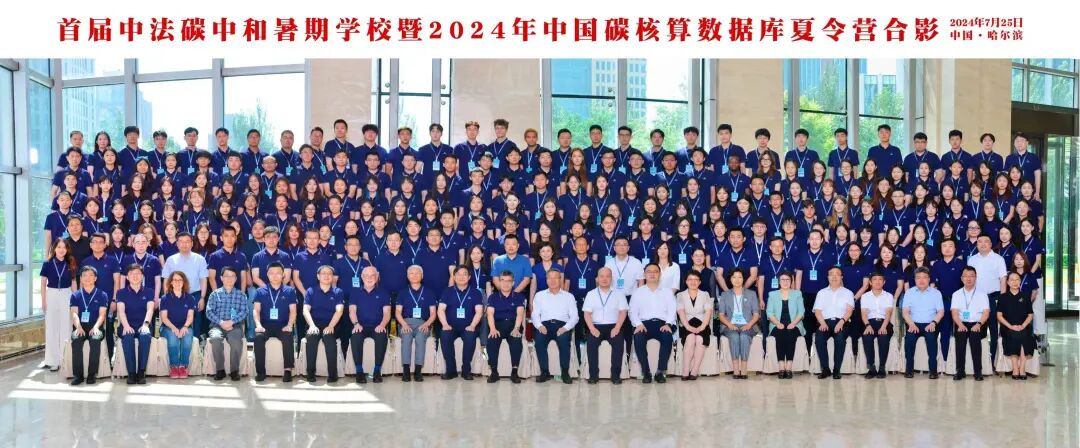
2024 Harbin
2024 Summer School Group: Tsinghua Road Group
2024 Summer School Group: English Research Group
2024 Summer School Group: Youth Group
3. 2025 CEADs Summer School
The 2025 CEADs Summer School is scheduled to take place from July 28 to August 6, 2025, in Huzhou, Zhejiang Province. The program will focus on carbon emissions accounting, carbon neutrality technology systems, and transition pathways for emerging economies. Through group activities, participants will study dual-carbon transition pathways for different countries, regions, and cities, and examine the socio-economic impacts of climate change.
The event is intended to implement the strategic guidance of the dual-carbon goals, train professionals in carbon mitigation with international perspectives, and help build a reserve of young talent for carbon peaking and carbon neutrality.
The CEADs Summer School Organizing Committee will consider applicant institutions, academic backgrounds, and related factors, and will admit applicants on a competitive basis. Where academic alignment is appropriate, the committee will in principle support at least one representative from each institution to ensure professional relevance, diversity, and interdisciplinarity among participants.
Zhejiang, Huzhou
03
Application Requirements

I. Basic Event Information
- Event dates: July 28 to August 6, 2025. Check-in is on July 27. Note: the summer school schedule has been adjusted. Registered students who are unable to attend should send an email to notify the organizers.
- Capacity: 130 participants.
- Venue: Huzhou, Zhejiang Province, China.
- Participation format: full in-person participation is required. No online participation option will be provided.
II. Application Guidelines
- Application materials and submission method: send a CV and one representative research paper, in Chinese or English, to Ceads2025@163.com. Email subject: "2025 Summer School - Name - Institution".
- Application deadline: May 31, 2025.
- Admission results: the organizer will notify admitted participants by email before June 15, 2025.
The organizers particularly encourage applications from senior undergraduates, master and doctoral students, and early-career faculty from central and western China, northeastern China, Hong Kong, Macao, Taiwan, and overseas institutions.
III. Specialized Group Information
1. English Research Group: three teams, each with eight to ten members.
The event will include English Research Groups. Applicants should be proficient in English and able to complete team assignments with young scholars from different countries.
- Application materials and submission method: send a CV and one representative research paper in English to Ceads2025@163.com. Email subject: "2025 Summer School - English Group - Name - Institution".
- Application deadline: May 31, 2025.
- Admission results: the organizer will notify admitted participants by email before June 15, 2025.
2. Junior Scholar Group: eight to ten participants.
The event will include a Junior Scholar Group for applicants aged 14 to 16. Priority will be given to applicants who are proficient in English communication, literature searching, and writing. Junior Scholar applicants must fully meet the Junior Scholar Character and Discipline Requirements listed below.
- Application materials and submission method: send a CV to Ceads2025@163.com. Email subject: "2025 Summer School - Junior Scholar Group - Name - School".
- Admission process: junior scholar applicants who pass the resume review will be interviewed by the CEADs team, and final admission results will be sent by email.
IV. Additional Notes
- Certificates and awards: at the end of the program, participants will receive a certificate of participation issued by the Tsinghua University Institute for Carbon Neutrality and will have the opportunity to compete for Best Team and Best Individual awards.
- Fees: no registration fee will be charged. Participants are responsible for their own transportation, accommodation, and meals.
- Contact: all questions related to this event may be sent to Ceads2025@163.com.
Junior Scholar Character and Discipline Requirements
I. Character Traits
1. Academic enthusiasm: show curiosity about interdisciplinary knowledge, actively explore questions, and have basic awareness of academic research.
2. Openness and inclusiveness: respect cultural diversity, actively collaborate with participants from different backgrounds, and adapt to an international communication environment.
3. Communication and collaboration: remain calm when encountering challenges in academic tasks or teamwork, and seek solutions through communication.
II. Discipline Guidelines
1. Academic self-discipline: complete group research tasks on time. Plagiarism and academic misconduct are strictly prohibited. Use reputable databases for literature searches.
2. Safety rules: participants may not leave the program or go out without permission from junior mentors. Participants must return to the hotel and attend roll call before 21:30 each evening.
3. Study discipline: mobile phones are prohibited during daytime group study sessions to ensure full participation in discussions. Daily phone access is from 19:00 to 21:30. Emergency use requires prior approval.