
CEADs Paper Wins ERL Best Early Career Article Award
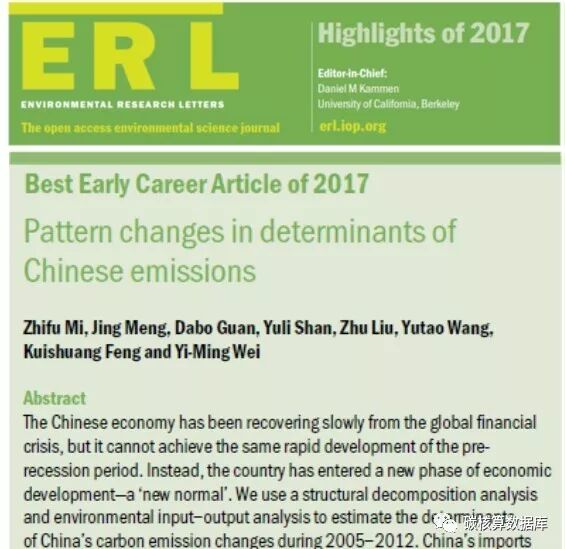
A CEADs paper published in the leading environmental journal Environmental Research Letters (ERL) received the 2017 Best Early Career Article Award. Only one article is selected for this honor each year. The award includes a trophy and a full waiver of publication charges for articles published in ERL in 2018. The selection considered article quality, significance, academic impact, public impact, and other criteria, and was decided by a vote of all editors. The first author is Dr. Zhifu Mi, formerly a postdoctoral researcher at the University of East Anglia and now a tenured researcher at University College London.
China has gradually entered the stage of the economic "new normal". Alongside slower economic growth, the country faces major challenges related to energy, the environment, and climate change. China is promoting the transformation of its social and economic development model through a series of systematic reforms, with the aim of improving the quality of economic growth. Patterns of production and consumption have changed significantly under the new normal. Against this background, the award-winning study examined the growth pattern of China carbon dioxide emissions from 2005 to 2012, focusing on the impact of the financial crisis and the shift in patterns under the new normal.
Based on the sectoral carbon emission inventories for China developed by the CEADs team, the paper used environmentally extended input-output analysis and structural decomposition analysis (SDA) to decompose changes in China carbon emissions into five driving factors: population, efficiency, production structure, consumption patterns, and consumption volume. The carbon emission inventory covers emissions from the combustion of 20 energy types across 47 sectors in China, as well as emissions from cement production processes.
The international financial crisis had a major impact on China carbon emissions. On the one hand, carbon emissions embodied in China exports declined during the crisis. As one of the three main drivers of China economic growth, exports had long been an important factor behind the increase in China carbon emissions. Under the impact of the financial crisis, however, the average annual growth rate of China exports dropped sharply from 10% in 2005-2007 to 2% in 2007-2010. As a result, export-related carbon emissions declined by 2.3% in 2007-2010. The effect was especially pronounced in industries with higher export dependence. Export emissions from the fabricated metal products industry and the textile industry fell by 26% and 15%, respectively, during 2007-2010. On the other hand, emissions driven by capital formation grew rapidly during the crisis. To counter the adverse impact of the international financial crisis and stabilize the domestic economy, the Chinese government introduced a package of measures including the four-trillion-yuan stimulus plan, with major investments in livelihood projects, infrastructure, and post-disaster reconstruction. Under its influence, more than 70% of China carbon emission growth in 2007-2010 came from capital formation, a much higher share than in other periods.
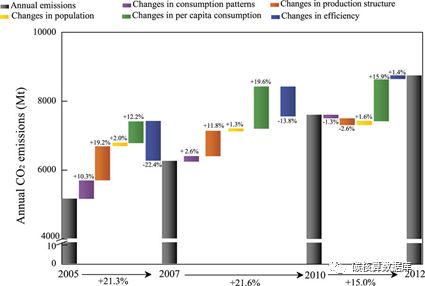
After China entered the economic new normal, the main factor restraining carbon emission growth shifted from efficiency improvement to structural upgrading. In the traditional development model, efficiency was the main factor reducing carbon emissions. In 2010-2012, however, efficiency contributed to a 1.4% increase in carbon emissions, indicating that the space for further efficiency gains was gradually narrowing. Under the new normal, production structure and consumption patterns became the main factors suppressing carbon emission growth. In the traditional development model, these two factors had contributed to emission growth. In 2010-2012, they instead drove reductions of 2.6% and 1.3%, respectively, reflecting structural upgrading on both the production and consumption sides. From the production perspective, production structure reduced emissions mainly because some highly emission-intensive industries accounted for a lower share of total inputs, including transport, electricity production and supply, and non-metallic mineral products. From the consumption perspective, consumption patterns reduced emissions mainly because some carbon-intensive industries accounted for a lower share of final use, including electrical equipment, machinery and equipment manufacturing, and the chemical industry.
After China entered the economic new normal, the growth pattern of carbon emissions began shifting from investment-driven to consumption-driven. The share of consumption-driven carbon emissions had been declining before 2010, but increased by 0.5 percentage points during 2010-2012. Although the increase was modest, it reflected the effects of policies to stimulate consumption and expand domestic demand. Under the new normal, China economy has begun to move away from the traditional investment-driven growth model and is gradually transitioning toward a path that places greater emphasis on quality, ecological civilization, livelihood improvement, and sustainability. The share of future consumption-driven carbon emissions in China is expected to continue rising, and the growth pattern of China carbon emissions is shifting from investment-driven to consumption-driven.
Award Link:
http://iopscience.iop.org/journal/1748-9326/page/Highlights-of-2017
Reference:
Mi Z, Meng J, Guan D, Shan Y, Liu Z, Wang Y, Feng K, Wei YM. 2017. Pattern changes in determinants of Chinese emissions. Environmental Research Letters. http://iopscience.iop.org/article/10.1088/1748-9326/aa69cf