
Climate Risk Assessment and Adaptation
-
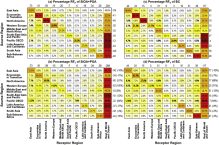
Socioeconomic and atmospheric factors affecting aerosol radiative forcing: Production-based versus cons
There exist substantial differences in top-of-atmosphere direct radiative forcing of aerosols due to a region's economic production (RF p ) and consumption (RF c ), in the context of economic globalization, trade and globalizing air pollution. Yet an explicit systematic analysis of all socioeconomic and atmospheric factors determining the RF difference is lacking. Here, we evaluate five socioeconomic (population, per capita output, emiss...
-

CEADs Research: An Economy-wide Water-Energy Nexus Analysis of 13 Cities in the Beijing-Tianjin-Hebei R
International attention to the water-energy nexus has remained strong. The quality, quantity, and accessibility of water resources are closely linked to energy pricing, diversity, stability, and sustainable development, while constrained energy supplies can also limit the production of clean water. Against the backdrop of current global environmental change and global trade, the influence of the water-energy nexus is expanding, and the ...
-
CEADs Research: Impacts of Climate Change on Global Barley Yield and the Beer Market
Food is the energy that sustains life, and human food consumption has shifted from eating enough to eating well. Food cultures such as eating happily are gradually becoming new standards for consumption. Although current research on the impacts of climate change on agriculture and agricultural product markets mainly focuses on staple grains, significant climate change will occur by 2050 or 2100, when human dietary structures will have c...
-
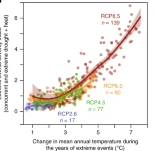
Decreases in global beer supply due to extreme drought and heat
Beer is the most popular alcoholic beverage in the world by volume consumed, and yields of its main ingredient, barley, decline sharply in periods of extreme drought and heat. Although the frequency and severity of drought and heat extremes increase substantially in range of future climate scenarios by five Earth System Models, the vulnerability of beer supply to such extremes has never been assessed. We couple a process-based crop model...
-
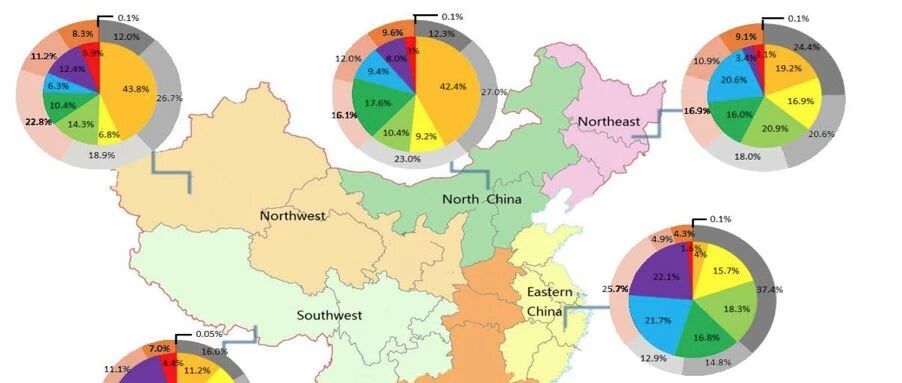
CEADs Research: Assessing the Air Pollution-Health-Economy Transmission Effects
In recent years, air pollution has become one of the most serious environmental problems in China. Severe air pollution greatly increases the risk of respiratory and cardiovascular diseases, acting as an invisible threat to public health. The long-term health impacts caused by air pollution also threaten the sustainable development of Chinese society and the economy by reducing productive labor and working time. Existing studies on the ...
-
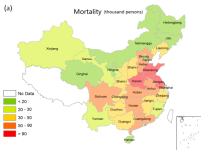
Assessment of the pollution–health–economics nexus in China
Serious haze can cause contaminant diseases that trigger productive labour time by raising mortality and morbidity rates in cardiovascular and respiratory diseases. Health studies rarely consider macroeconomic impacts of industrial interlinkages while disaster studies seldom involve air pollution and its health consequences. This study adopts a supply-driven input–output model to estimate the economic loss resulted from disease-induced...
-
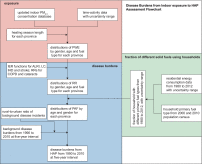
Estimating household air pollution exposures and health impacts from space heating in rural China
Exposure to and the related burden of diseases caused by pollution from solid fuel cooking, known as household air pollution (HAP), has been incorporated in the assessment of the Global Burden of Diseases (GBD) project. In contrast, HAP from space heating using solid fuels, prevalent in countries at middle or high altitudes , is less studied and missing from the GBD assessment. China is an ideal example to estimate the bias of exposure ...
-
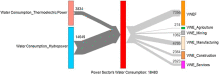
Categorising virtual water transfers through China’s electric power sector
Water consumption in thermoelectric and hydropower plants in China increased from 1.6 and 6.1 billion m 3 , respectively, to 3.8 and 14.6 billion m 3 from 2002 to 2010. Using the concept of virtual water, we attribute to different electricity users the total water consumption by the electric power sector. From 2002 to 2010, virtual water embodied in the final consumption of electricity (hereinafter referred to as VWEF) increased from 1.9...
-
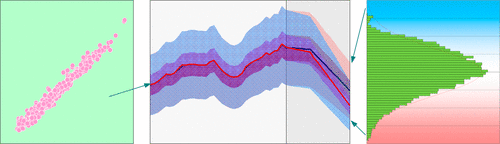
Distinguishing Emission-Associated Ambient Air PM2.5 Concentrations and Meteorological Factor-Induced F
Although PM 2.5 (particulate matter with aerodynamic diameters less than 2.5 μm) in the air originates from emissions, its concentrations are often affected by confounding meteorological effects. Therefore, direct comparisons of PM 2.5 concentrations made across two periods, which are commonly used by environmental protection administrations to measure the effectiveness of mitigation efforts, can be misleading. Here, we developed a two-...
-
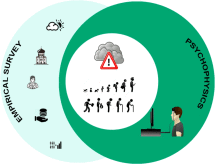
A review of air pollution impact on subjective well-being: Survey versus visual psychophysics
Air pollution is a worldwide environmental and health issue, especially in major developing countries. A recent World Health Organization report shows about 3 million deaths in the world in 2012 are due to ambient air pollution and China and India are the countries with the most severe challenge. Air pollution influences people's thought and experience of their lives directly by visual perceptions. This reduces people's subjective well-...