
Carbon Emissions Accounting
-
Linking city-level input-output table to urban energy footprint:Construction framework and application
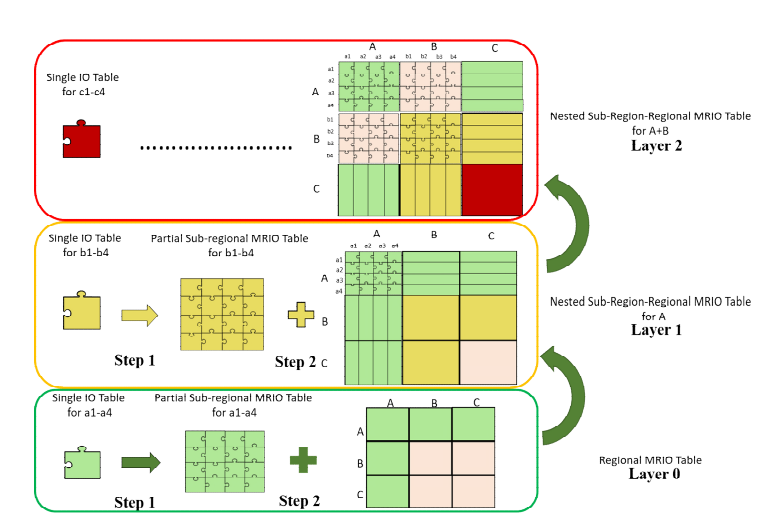
Multiregion input-output (MRIO) models have become increasingly important in economic and environmental analysis. However, the current resolution of most MRIO models fails to capture the heterogeneity between subregions, especially in cities. The lack of city-level MRIO tables has impeded the accomplishment of city-level studies and hampered the understanding of the relationship between urban growth and consumption, and teleconnections ...
-
Carbon emissions of cities from a consumption-based perspective
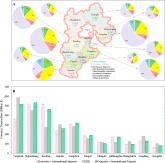
Carbon emission inventories are the foundations of climate change mitigation and adaptation in cities. In this study, we estimated production-based CO 2 emissions from fossil fuel combustion and industrial processes in eleven cities in Hebei Province of China in 2012 and used input-output theory to measure their consumption-based CO 2 emissions. By comprehensively comparing production- and consumption-based emissions, we found that six d...
-
Temporal change in India’s imbalance of carbon emissions embodied in international trade
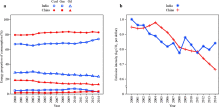
In India, rapid industrialization and reorganization of the global supply chain are driving economic growth, accompanied by increasing exports and carbon emissions. India is poised to succeed China as the next world manufactory, which will lead to huge emissions in the country. To formulate appropriate emission mitigation measures, it is necessary to further understand the temporal change in India’s emissions at the sectoral level fro...
-
Integrating Sustainability Into City-level CO2 Accounting: Social Consumption Pattern and Income Distri
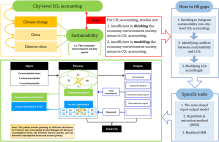
From a sustainability perspective, city-level CO 2 emissions require reconsiderations. Correspondingly, the economy-environment-society nexus should be incorporated into city-scale CO 2 accounting. Therefore, in this study, the semi-closed IO model is integrated with a HEM to calculate CO 2 emissions arising from the social consumption pattern and income distribution, and to explore economic drivers behind CO 2 variations. This method i...
-
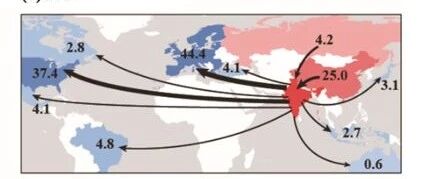
CEADs Research: India's Net Carbon Exports in International Trade Are Gradually Increasing
While international trade has promoted rapid economic development, it has also geographically separated the producers and consumers of goods, profoundly affecting the distribution of global carbon emissions. Since China's economy entered the "new normal", continuous industrial upgrading and energy-structure optimization have caused China's overall carbon emissions and export-embodied carbon to peak. Whether the next phase of carbon redu...
-
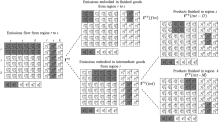
The role of intermediate trade in the change of carbon flows within China
In recent years, evaluating the emissions embodied in trade (EEIT) has become an important area of policy and research. Multiregional input-output (MRIO) analysis, which links producers and final consumers, is a widely-used method for quantifying the EEIT. However, the role of intermediate trade in driving changes in the EEIT is still not fully incorporated in MRIO analysis and as a result poorly understood. Here, we present a framework ...
-
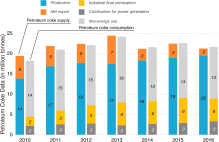
Rapid growth of petroleum coke consumption and its related emissions in China
Petroleum coke, a non-environmentally friendly energy source, is gradually replacing other power fuels in China’s industrial enterprises because of its price advantage. Petroleum coke has high emission factors and thus emits more greenhouse gases (GHGs) and air pollutants than even raw coal. This study first examines the rapid growth of petroleum coke consumption in China since 2010 by industry sector and region and then estimates the ...
-
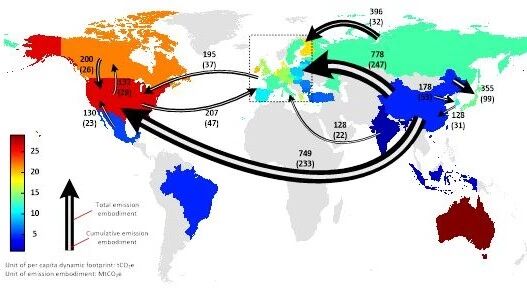
[CEADs Collaboration] Capital Accumulation Causes Significant Overestimation of Embodied Greenhouse Gas
Current greenhouse gas emissions accounting is mainly divided into two systems: producer-responsibility accounting and consumer-responsibility accounting. Previous studies held that the difference between the emissions results a country obtains under these two systems, that is, the difference between direct emissions and embodied emissions, was caused by spatial carbon leakage. Building on previous research, the CEADs team, together wit...
-
Estimating perfluorocarbon emission factors for industrial rare earth metal electrolysis
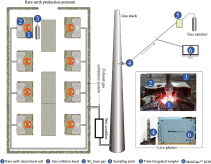
Rare earth (RE) metals have been widely applied in new materials, leading to their drastic production increase in the last three decades. In the production process featured by the molten-fluoride electrolysis technology, perfluorocarbon (PFC) emissions are significant and therefore deserve full accounting in greenhouse gas (GHG) emission inventories. Yet, in the ‘ 2006 IPCC Guidelines for National Greenhouse Gas Inventories ’, no met...
-
A multi-regional input-output table mapping China's economic outputs and interdependencies in 2012
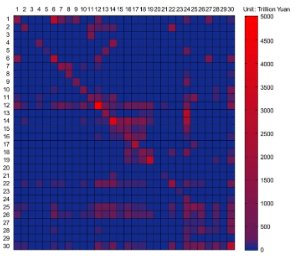
Multi-regional input-output (MRIO) models are one of the most widely used approaches to analyse the economic interdependence between different regions. We utilised the latest socioeconomic datasets to compile a Chinese MRIO table for 2012 based on the modified gravity model. The MRIO table provides inter-regional and inter-sectoral economic flows among 30 economic sectors in China’s 30 regions for 2012. This is the first MRIO table to ...