
Carbon Emissions Accounting
-
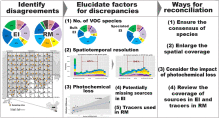
Reconciling discrepancies in the source characterization of VOCs between emission inventories and recep
Emission inventory (EI) and receptor model (RM) are two of the three source apportionment (SA) methods recommended by Ministry of Environment of China and used widely to provide independent views on emission source identifications. How to interpret the mixed results they provide, however, were less studied. In this study, a cross-validation study was conducted in one of China's fast-developing and highly populated city cluster- the Pearl...
-
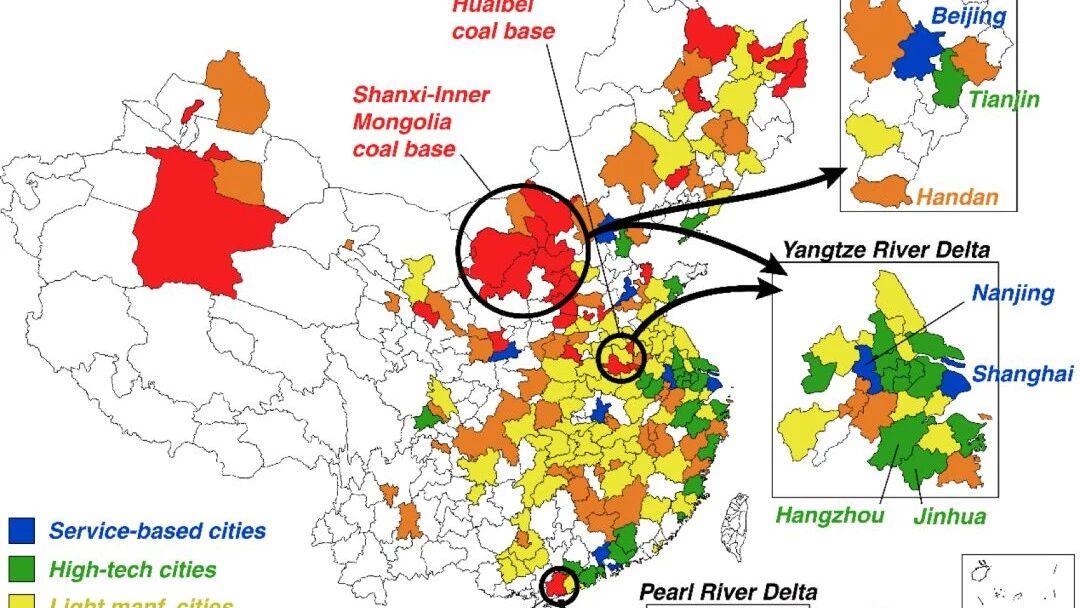
CEADs Team Releases Carbon Emission Inventories for 182 Chinese Cities: Science Advances Paper Discusse
The CEADs team has released the first 2010 carbon emission inventories for 182 Chinese cities compiled through a "co-planned and co-developed" process. The compilation and validation of these inventories took more than two years. Nearly one hundred teachers and students from research institutions participated voluntarily and jointly validated the inventories. The city-level carbon emission inventories are highly consistent with national...
-

CEADs Research: Embodied Carbon Emissions in China's Exports Have Peaked
International trade-related carbon emissions account for more than 20% of global carbon emissions. Consumption in developed countries can drive carbon emissions in developing countries. Exports have been one of the three engines of China's economic development, but they have also contributed to substantial growth in carbon emissions. Since China entered the new normal, its economic development model has changed significantly, and its po...
-
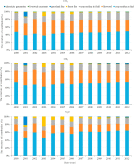
The spatiotemporal features of greenhouse gases emissions from biomass burning in China from 2000 to 20
Greenhouse gases emissions from biomass burning have been given a little attention, especially the spatiotemporal features of biomass burning sources and greenhouse gases emissions have not been comprehensively uncovered. This research undertook IPCC bottom-up inventory guideline to estimate Chinese greenhouse gases emissions from biomass burning and applied geographical information system to reveal biomass burning emissions spatiotempo...
-
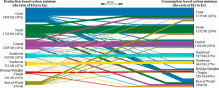
Carbon emission imbalances and the structural paths of Chinese regions
As the Chinese regions become more and more connected to each other and foreign countries, this study aims to address carbon imbalance and outsourcing issues in China. Using a production-based carbon emission inventory and a China-global multi-regional input-output model, this study estimates the consumption-based carbon emissions in 30 Chinese regions in 2007 and 2010. Our results reveal that the carbon imbalances of most Chinese provin...
-
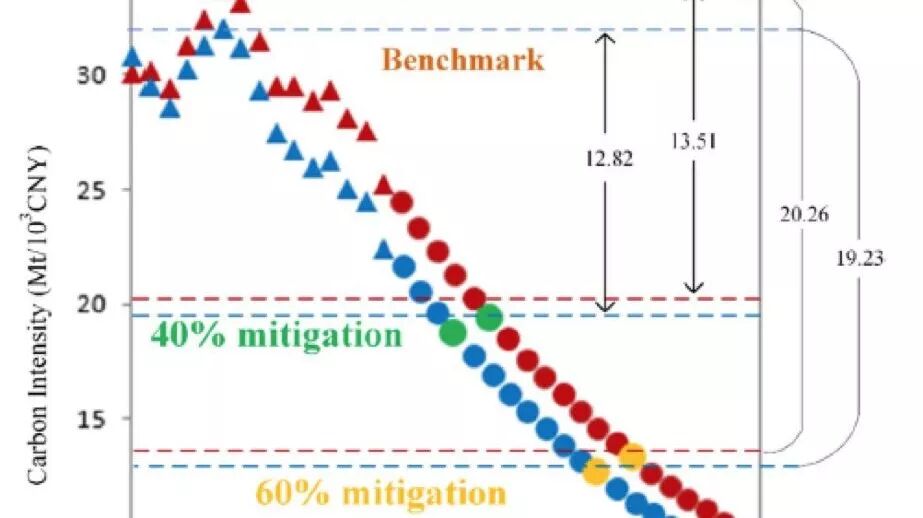
CEADs Data: How Multiple Revisions to Energy Statistics Affect the Achievement of Carbon Mitigation Tar
As the world's largest energy consumer and carbon emitter, China plays a critical role in achieving global emission reduction targets. To this end, the Chinese government has implemented strong mitigation measures and made independent mitigation commitments to the world: reducing carbon intensity by 40-45% and 60-65% from the 2005 level by 2020 and 2030, respectively (the 40/45 and 60/65 targets), and peaking carbon emissions before 203...
-

CEADs Publishes China CO2 Emission Accounts 1997-2015 in the Nature Portfolio Journal Scientific Data
Data are the foundation of work on climate change. Accurate measurement of national and regional carbon dioxide emissions is a prerequisite for subsequent related research and for formulating low-carbon emission-reduction policies. In the Paris Agreement, the transparency, accuracy, completeness, comparability, and consistency of carbon emission data were formally included in the agreement. The CEADs database has long been committed to ...
-
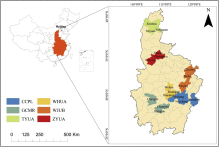
Patterns of CO2 emissions in 18 central Chinese cities from 2000 to 2014
With the Rise of Central China Plan, the central region has had a great opportunity to develop its economy and improve its original industrial structure. However, this region is also under pressure to protect its environment, keep its development sustainable and reduce carbon emissions . Therefore, accurately estimating the temporal and spatial dynamics of CO 2 emissions and analysing the factors influencing these emissions are especiall...
-
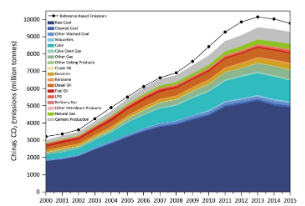
China CO2 emission accounts 1997–2015
China is the world’s top energy consumer and CO 2 emitter, accounting for 30% of global emissions. Compiling an accurate accounting of China’s CO 2 emissions is the first step in implementing reduction policies. However, no annual, officially published emissions data exist for China. The current emissions estimated by academic institutes and scholars exhibit great discrepancies. The gap between the different emissions estimates is ap...
-
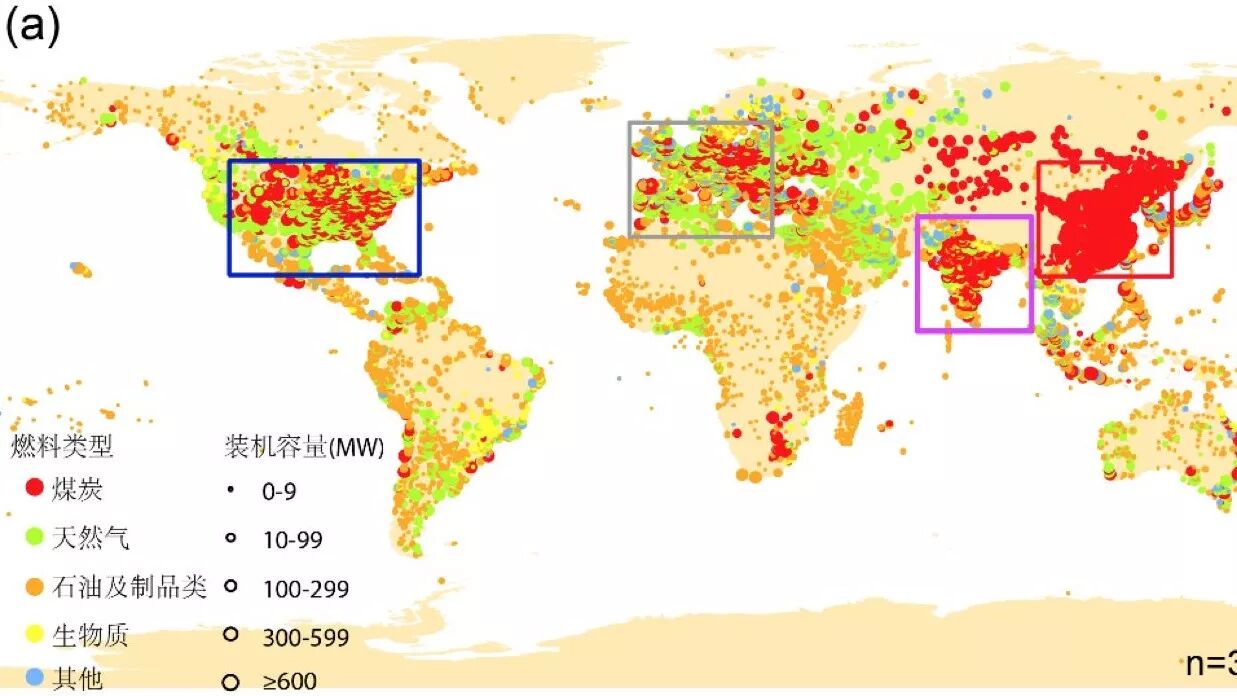
CEADS Team Reveals the Emission Contributions of Global Super-Polluting Power Plant Units and Releases
Greenhouse gases and air pollutants emitted during fossil energy use have serious impacts on climate change, air quality and human health. Fossil energy consumption in the power sector accounts for about 50% of total global consumption, making it one of the most important targets for global greenhouse gas mitigation and air pollution control. Measurable, reportable and verifiable monitoring is a basic requirement of the international co...